From Gundam to Reality: The 40-Year Wait for Our Robotic Future
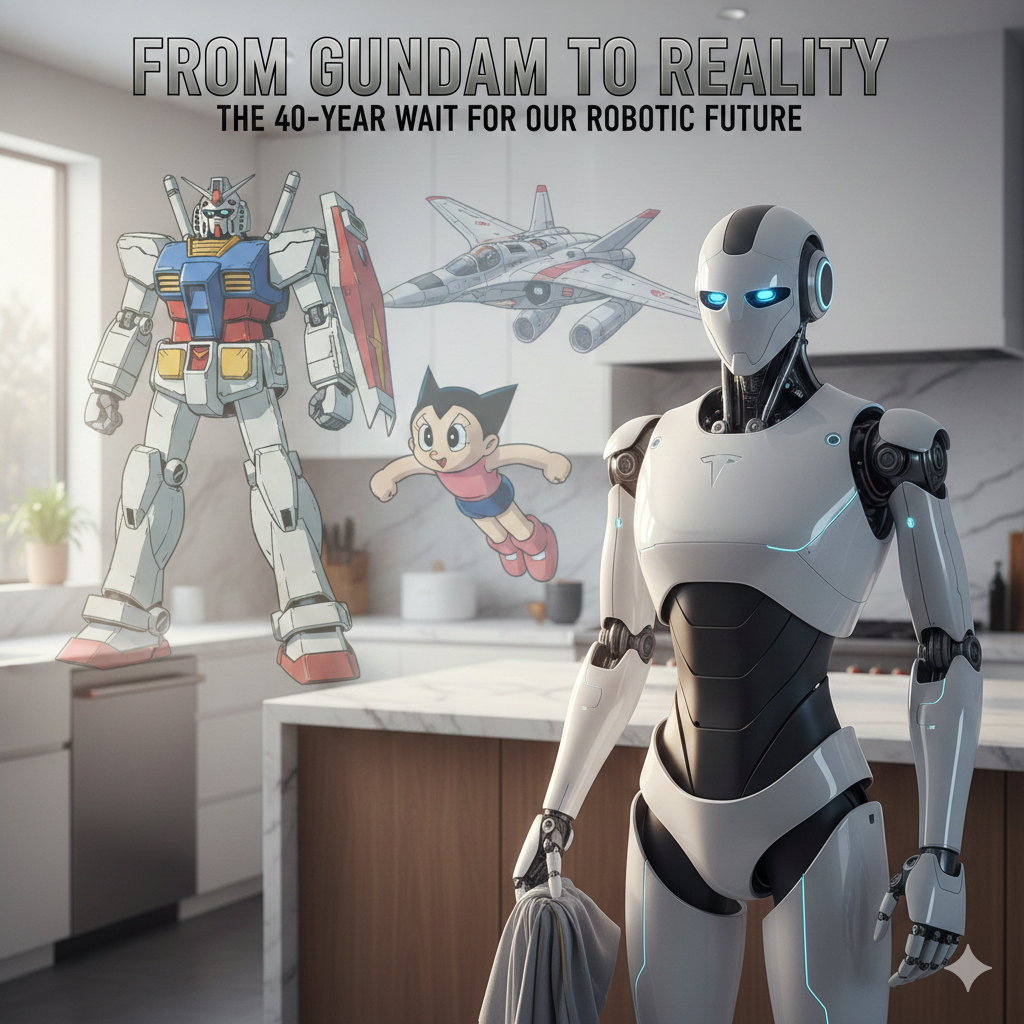
For those of us who grew up in the 1980s and 90s, the "future" arrived every Saturday morning. Whether it was the sleek heroics of Astro Boy, the massive scale of Mobile Suit Gundam, or the transforming wonder of Macross and Transformers, we were promised a world where intelligent robots were our partners, protectors, and household helpers.
We expected to see them by the year 2000. Instead, we got the Roomba.
It has taken more than 40 years, but as we navigate 2025, the gap between science fiction and reality is finally closing.1 We have reached a pivotal moment: we have finally built the "brain," but we are still perfecting the "body."
1. The Breakthrough: The AI "Brain"
For decades, the biggest hurdle wasn't just metal and wires; it was the mind. Traditional robots were rigid, following "if-then" code. If a chair was moved three inches to the left, the robot would crash into it.
The arrival of Generative AI and Large Language Models (LLMs) changed everything. We now have "Physical AI" (or Embodied AI), which allows robots to:
- Understand Natural Language: You can tell a robot, "I spilled some juice, find something to clean it with," and it can reason that it needs to find a sponge or paper towel.
- Computer Vision: Modern robots use neural networks to identify objects in real-time, just like a human eye, allowing them to navigate messy, unpredictable homes.
- Real-time Learning: Companies like Figure AI and Tesla are showing robots that learn tasks—like sorting laundry or making coffee—simply by watching video demonstrations.
2. The Physical Hurdle: Why the "Body" is Hard
While the AI brain is evolving at light speed, the physical hardware is fighting the laws of physics. Making a robot move like a human is an engineering nightmare.
Challenge The Current Reality in 2025 Battery Life Most humanoids currently run for only 2 to 5 hours before needing a charge. Dexterity Replicating the human hand (with its 27 bones and thousands of nerves) is incredibly expensive and fragile. Cost A high-end humanoid like the Tesla Optimus or Figure 02 still costs upwards of $100,000 to $200,000 to produce. Safety A 150lb metal machine malfunctioning in a kitchen is a serious safety risk compared to a software bug on a phone. ---
3. The Timeline: When Will They Be "Real"?
We are currently in the "Early Industrial" phase. You won't see a robot butler in your neighbor's house tomorrow, but you will see them in the following waves:
- 2025–2027 (The Warehouse Era): Robots like Agility Robotics' Digit and Apptronik’s Apollo are already entering factories.2 They are doing "dull, dirty, and dangerous" tasks like moving empty bins and unloading trucks.
- 2028–2032 (The Specialized Service Era): Expect to see humanoids in hospitals (carrying linens), hotels (room service), and large retail stores.3
- 2035 and Beyond (The Domestic Era): This is the "Gundam Dream" phase. Experts predict that by 2035, the cost of a general-purpose humanoid could drop to $20,000—the price of a small car. This is when they will finally enter our homes to do the dishes, fold the laundry, and watch the house.
Conclusion: The Dream is Deferred, Not Denied
The kids of the 80s weren't wrong; we were just early. We spent 40 years waiting for the hardware to catch up to our imagination. Today, the "brain" is ready, and the "body" is finally starting to walk. We are moving from an era where we watched robots on a screen to an era where we will pass them in the hallway.
The intelligent robots of our childhood are finally arriving—they just took the scenic route.
You May Also Like

Comments
0Leave a Comment
Share your thoughts with us
No comments yet
Be the first to share your thoughts!